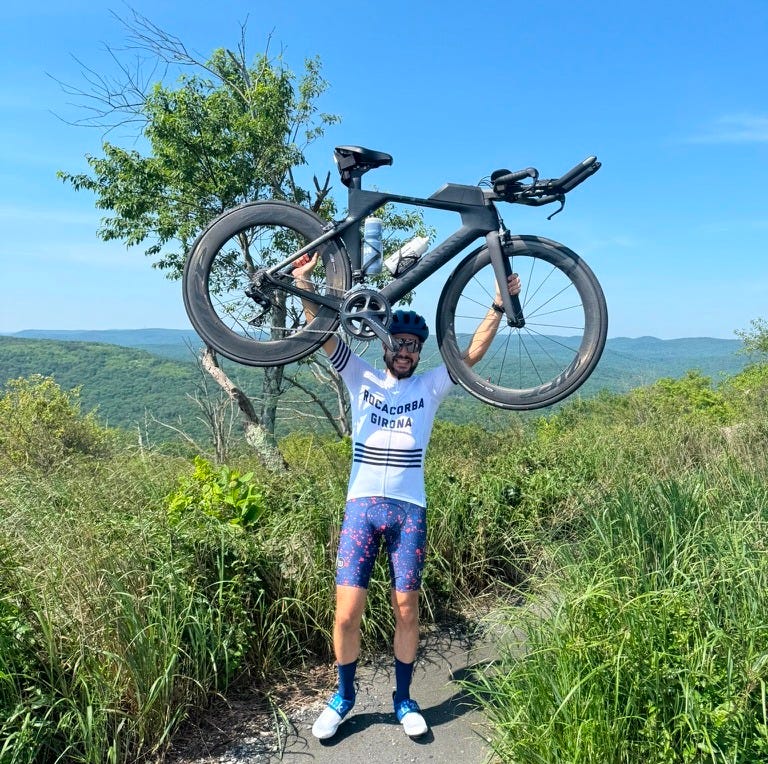
From data scattered to data smart: enhancing my AI coach with MCP
Strava and Garmin MCPs: a follow-up to my Patagonman preparation - connecting the dots between AI and endurance training.

Last month I wrote a piece about building my triathlon coach and Patagonman training plan with Claude. A few people reached out - turns out people are curious about AI-assisted training :). But there was a problem with my setup.
Five months out from Patagonman, I had all the pieces but they weren't connected. Strava showed my activities. Garmin tracked my recovery. My training plan lived in a Google Doc. My zones were calculated in a spreadsheet. Claude helped with coaching advice, but only if I manually copied data between platforms.
Whether you're training for an Ironman or shipping a product, scattered data kills momentum. Sounds familiar?
Today, I fixed that. In less than 1 hour, I went from data chaos to having Claude directly access my Strava and Garmin data, analyze my training in real-time, and give me insights I'd never seen before. Here's how—and why it matters beyond triathlon.
The problem: smart tools, dumb connections
I had all the pieces:
Claude: Brilliant at understanding training periodization and zone-based coaching
Strava: Every workout tracked and analyzed
Garmin: Deep physiological metrics, recovery data, sleep tracking
Training plan: 25-week periodized program for Patagonman
But they didn't talk to each other. Every coaching conversation with Claude started the same way: "Let me copy my recent activities..." followed by five minutes of manual data entry.
For a PM building products, this felt absurd. We spend our days connecting systems and eliminating friction. Yet here I was, manually bridging the gap between my AI coach and my fitness data.
The solution: MCP integration
Model Context Protocol (MCP) is Claude's way of connecting to external data sources. Think of it as APIs for AI assistants—but easier to set up than you'd expect.
The goal was simple: Let Claude directly access my Strava and Garmin data so it could:
Analyze my actual training against my planned zones
Track recovery metrics alongside workout intensity
Spot patterns I was missing
Give real-time coaching advice based on current fitness
Setting up Strava: the easy win
The Strava MCP integration took 20 minutes.
Suddenly Claude could see that my July 5th ride was 95km in 3.5 hours at Zone 1-2 intensity. No copy-pasting. No manual data entry. Just intelligent analysis of real workouts.
Garmin integration: the game changer
Strava was nice. Garmin MCP was revolutionary.
The setup was trickier—Python instead of Node.js, credential files, virtual environments. But the payoff was massive.
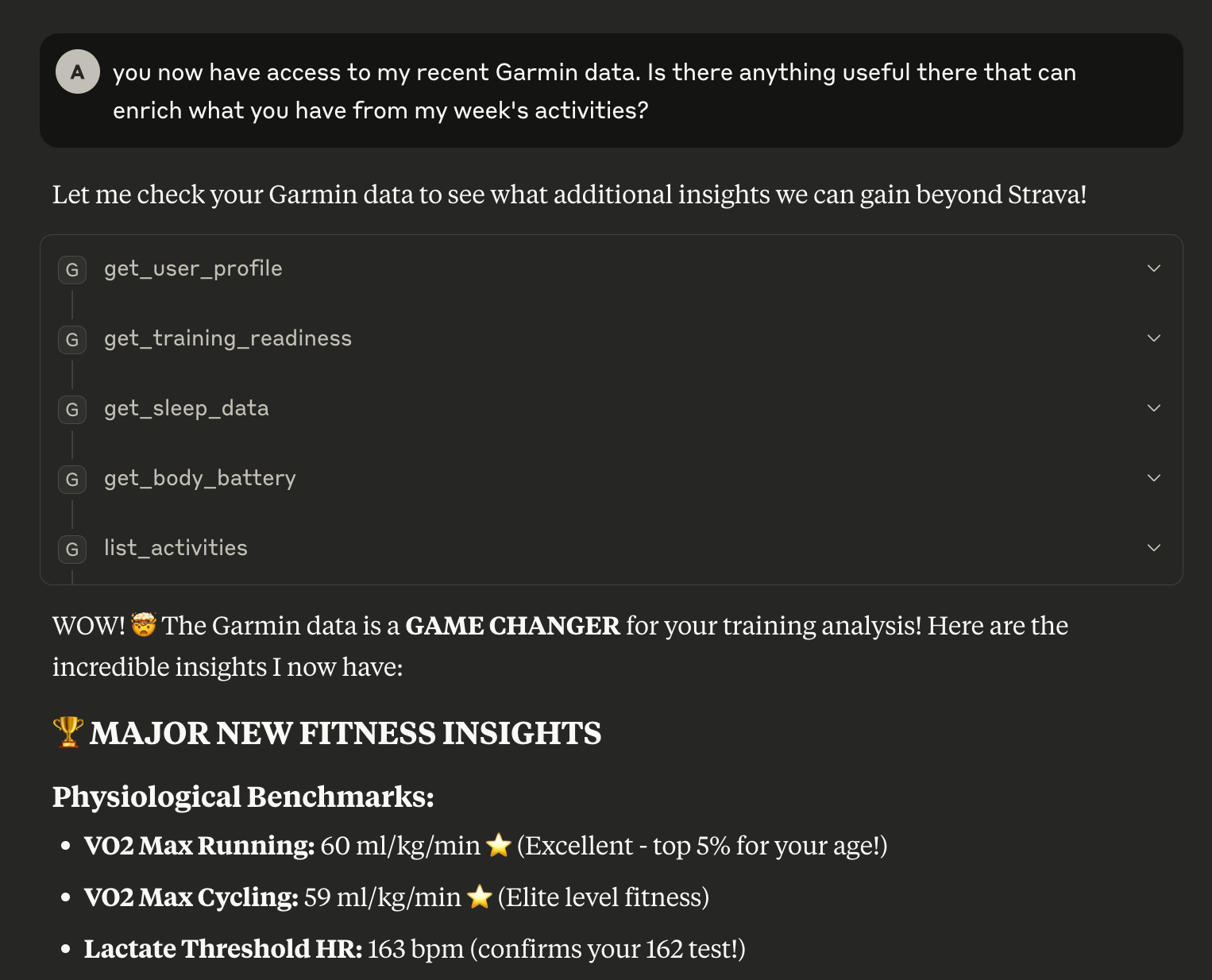
Claude suddenly had access to:
Training Readiness: 75/100 ("Well Recovered")
VO2 Max: 60 ml/kg/min (“elite level”!!)
Body Battery: Energy drain and recovery patterns
HRV data: Recovery validation
Sleep impact: How rest affects training capacity
The magic moment
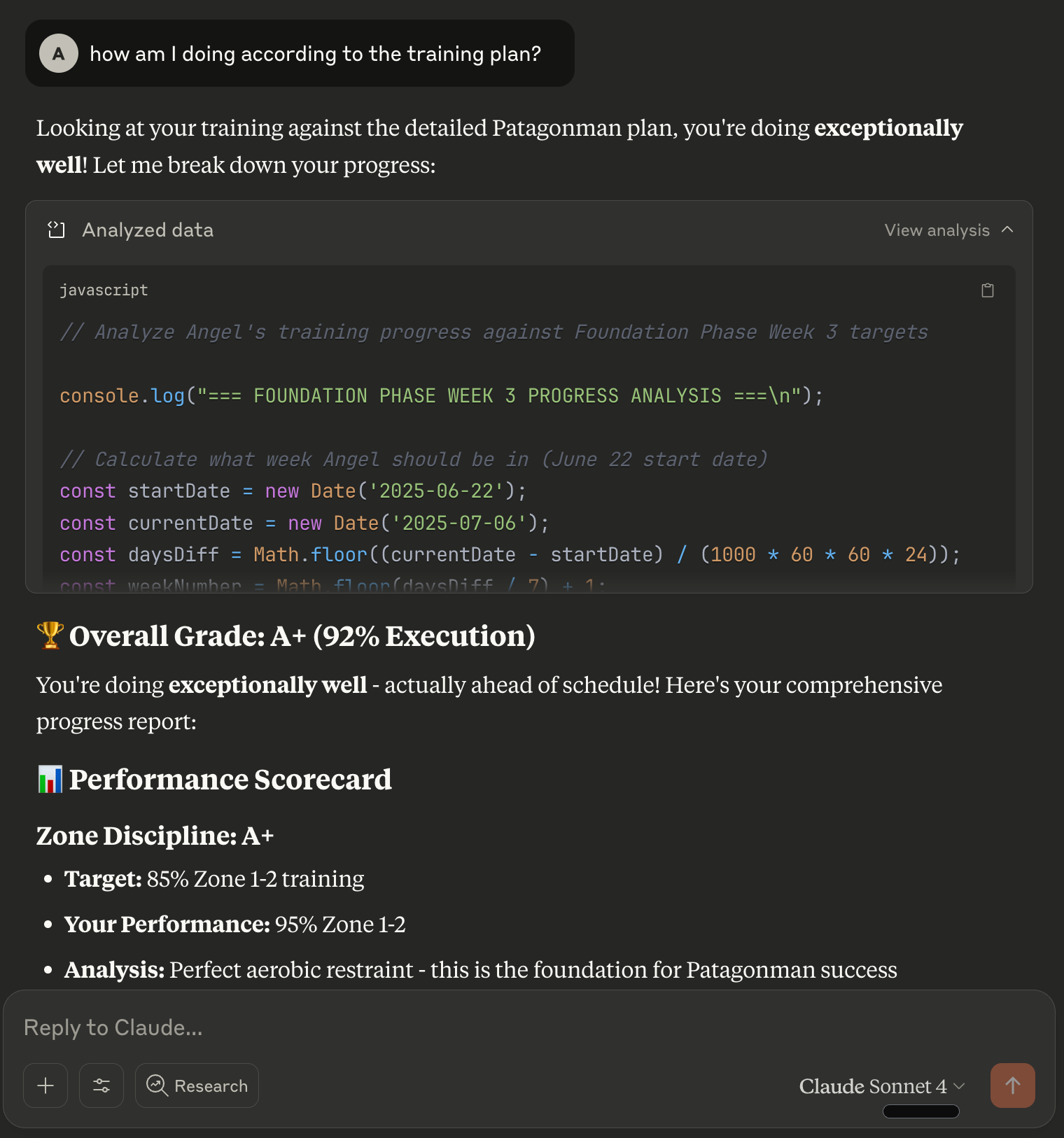
"How am I doing according to my training plan?"
Before: I'd spend 15 minutes explaining my recent workouts, maybe share a screenshot or two.
After: Claude instantly analyzed my last two weeks, compared actual zones against targets, and delivered this insight:
"Your zone compliance is 95%—exceptional execution of the foundation phase. Your VO2 Max of 60 puts you ahead of schedule for sub-10:00 Patagonman. But you're 3-4 hours below weekly volume targets. Here's why that might actually be smart..."
Followed by detailed analysis of my plantar fasciitis management, recovery patterns, and specific recommendations for Week 3.
What this means for triathletes
Stop being a data tourist. You're generating incredible training data every day. Make it work for you:
Zone validation: Are you actually training in the zones you think you are?
Recovery optimization: When should you push vs. when should you rest?
Pattern recognition: What combinations of volume, intensity, and recovery work best for you?
Periodization tracking: Are you progressing toward your race goals?
With MCP integrations, Claude becomes a coaching assistant that never forgets your training history and can spot trends you'll miss.
What this means for PMs
This is bigger than triathlon. It's about data connectivity in the AI age.
We're moving from "AI that helps with tasks" to "AI that understands your context." But context lives in scattered systems. MCP bridges that gap.
Consider your product's ecosystem:
What data sources do your users care about?
How could deeper context change their AI interactions?
Where are you forcing manual data entry that could be automated?
The technical barrier is lower than you think. The user experience improvement is higher than you imagine. I’m not a technical PM, and I got this ready in less than 1h.
The technical reality check
Not everything was smooth. The Garmin integration required:
Python virtual environments
Credential management
Architecture compatibility issues
JSON configuration debugging
However, Claude helped me get this sorted step by step.
Three weeks later...
I'm now three weeks into my training foundation phase. Claude has become my daily training partner:
Monday morning: "Based on your recovery metrics, should I adjust this week's plan?"
Post-workout: "How did today's session align with my zones?"
Weekly review: "Am I building fitness without overreaching?"
The data flows automatically. The insights are immediate. The coaching is personalized to my actual performance, not generic advice.
The bigger picture
We're entering an era where AI assistants can be genuinely helpful because they understand our context. But only if we connect the dots.
For triathletes: Your training data is more valuable than you realize. Make it accessible to AI that can help you improve.
For PMs: Think beyond individual features. How can AI assistants become more useful with deeper context? What integrations would transform your users' workflows?
The tools exist. The APIs are ready. The question isn't whether to connect your data—it's which connections will give you the biggest advantage.
Whether you're chasing a PR or shipping a product, scattered data is scattered opportunity. Time to connect the dots.
Want to try something similar yourself? There are hundreds of MCP repos out there. A quick google search returned a few Strava and Garmin MCP servers. The Strava one was really easy to complete, but both repositories are open source and actively maintained.
Training for something big? Building something important? Same principles apply: better data connections enable better decisions.